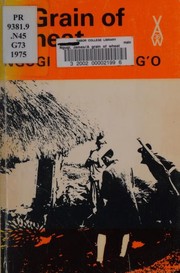
Summary
A Grain of Wheat is a historical novel written by Kenyan novelist Ngũgĩ wa Thiong'o, first published as part of the influential Heinemann African Writers Series. It was written while he was studying at Leeds University and first published in 1967 by Heinemann. The title is taken from the Gospel of John, 12:24.
Source: Wikipedia (CC BY-SA).
Historical Background
A Grain of Wheat (1967) was written by Ngũgĩ wa Thiong'o while he was a student at Leeds University and published by Heinemann in its influential African Writers Series. It is set around Kenya's Uhuru (independence) celebrations of December 1963, marking the transition from British colonial rule and the violence of the Mau Mau Emergency to nationhood. The novel reflects Ngũgĩ's deepening engagement with anti-colonial politics and disillusionment with the compromises of the new Kenyan elite. Structurally it moves between the "present" of independence-day preparations in the village of Thabai and flashbacks reconstructing the Emergency years, detention camps, forced labour, and betrayals within the resistance movement. The title is drawn from the Gospel of John 12:24 ("Except a corn of wheat fall into the ground and die, it abideth alone: but if it die, it bringeth forth much fruit"), signalling the novel's central preoccupation with sacrifice, guilt, and rebirth. The book is widely read as Ngũgĩ's first mature political novel, moving beyond the more overtly anti-colonial narrative of his earlier fiction toward a morally complex, multi-voiced examination of heroism, betrayal, and the unfulfilled promises of independence.
The Story
Set in the village of Thabai in the days leading up to Kenya's independence celebrations of 12 December 1963, the novel unfolds through shifting perspectives and flashbacks that piece together the community's experience of the Mau Mau uprising and the colonial Emergency. At its centre is Mugo, a reclusive villager secretly haunted by guilt: he betrayed the resistance leader Kihika to the colonial authorities, an act that led to Kihika's execution, yet Mugo is publicly regarded as a hero for having endured detention without confessing. As independence day approaches, the villagers plan to honour Mugo at a public ceremony, unaware of his secret. Interwoven are the stories of Gikonyo, a carpenter and former detainee tormented by his wife Mumbi's relationship with another man during his imprisonment; Mumbi herself, caught between loyalty and desire; and General R. and Lieutenant Koina, former fighters seeking to identify Kihika's betrayer. As the independence celebrations near, Mugo's confession of his betrayal becomes the novel's moral climax, forcing the community to confront the compromised, often ambiguous nature of heroism and sacrifice during the liberation struggle, even as the promise of Uhuru is shadowed by emerging social and political disillusionment.
Themes
- Betrayal and guilt
- Sacrifice and redemption
- Colonialism and its aftermath
- Heroism versus complicity
- Community versus individual conscience
- The ambiguity of independence (Uhuru)
- Love, marriage, and personal loyalty amid political upheaval
- Memory and the reconstruction of history
Literary Devices
- Multiple/shifting narrative perspective — the story is pieced together from several characters' viewpoints rather than a single authoritative narrator
- Non-linear, fragmented chronology — flashbacks to the Emergency interrupt the independence-day present, mirroring the community's fractured memory
- Christian/biblical allusion — the title and imagery of sacrifice draw on the Gospel of John to frame political martyrdom
- Symbolic naming and imagery — recurring motifs of rain, seeds, and land tie personal guilt to communal renewal
- Free indirect discourse — access to characters' interior guilt and rationalization, especially Mugo's
- Irony — the celebrated 'hero' is secretly the betrayer, undercutting official narratives of the independence struggle
Symbolism
- The grain of wheat — sacrifice that must 'die' (confession/exposure) to bring communal renewal
- Rain — cleansing, renewal, and the uncertain promise of the new nation
- Detention camps — the physical and psychological cost of colonial repression
- Kihika — the martyred freedom fighter as a Christ-like sacrificial figure
Critical Interpretation
Critics have located A Grain of Wheat as a pivotal transitional work in Ngũgĩ's career, moving from the relatively straightforward nationalist narratives of Weep Not, Child and The River Between toward a more formally complex and morally ambivalent political fiction, influenced by his reading of Conrad and by Fanonist thought on the psychology of colonized and liberation movements. Postcolonial critics have examined the novel's interrogation of heroism and its refusal to offer a simple redemptive narrative of independence, instead exposing the compromises, betrayals, and disappointments that attend decolonization. Feminist readings have attended to Mumbi's position as a woman whose body and choices become a site of political and marital conflict. The novel is also frequently discussed for its narrative technique — its fragmented, multi-voiced structure has been read as formally enacting the difficulty of arriving at a single, reliable account of collective trauma and resistance history.
Quotations
Verily, verily, I say unto you, Except a corn of wheat fall into the ground and die, it abideth alone: but if it die, it bringeth forth much fruit.
The biblical epigraph that gives the novel its title and frames its theme of sacrificial death enabling communal renewal.
Influence
A Grain of Wheat is regarded as a landmark in African anti-colonial and postcolonial fiction, deepening the tradition established by Chinua Achebe's Things Fall Apart by turning a critical eye on the moral costs of liberation struggle itself rather than only on colonial injustice. It anticipated Ngũgĩ's later, more explicitly Marxist and increasingly experimental fiction (Petals of Blood, Devil on the Cross) and his eventual turn to writing in Gikuyu. The novel's unflinching portrayal of betrayal within a liberation movement, and its skepticism toward the immediate fruits of independence, influenced subsequent generations of African writers examining the disillusionments of the post-independence state across the continent.
Related Works
- Things Fall Apart by Chinua Achebe
- Weep Not, Child by Ngũgĩ wa Thiong'o
- The River Between by Ngũgĩ wa Thiong'o
- Petals of Blood by Ngũgĩ wa Thiong'o
- Nervous Conditions by Tsitsi Dangarembga
Curator's Notes
- 1The novel was written while Ngũgĩ was a postgraduate student at Leeds University in England.
- 2It was first published in 1967 by Heinemann as part of the landmark African Writers Series.
- 3The title is a direct biblical quotation from the Gospel of John, chapter 12, verse 24.
- 4Ngũgĩ later revised the novel for a 1986 edition, sharpening some of its political content.
For the Exam
UGC NET English commonly tests A Grain of Wheat on: its place in Ngũgĩ's oeuvre and the shift from early nationalist fiction to a more complex postcolonial narrative; the Mau Mau uprising as historical backdrop; the theme of betrayal versus heroism embodied in Mugo; the novel's fragmented, multi-perspectival narrative technique; the biblical source and symbolism of the title; and its treatment of the disillusionment surrounding Kenyan independence (Uhuru). Candidates should also know Ngũgĩ's biographical facts and his later shift to writing in Gikuyu.