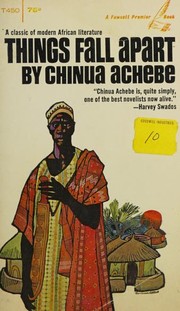
fiction literature · 1958
Things Fall Apart
1958 novel by Chinua Achebe
- 1958
- fiction literature
- historical fiction
Summary
Things Fall Apart is the 1958 debut novel by Nigerian author Chinua Achebe. Set in Colonial Nigeria, it portrays the story of Okonkwo, a traditional and influential leader of the fictional Igbo clan of Umuofia, who opposes colonialism and early Christianity. Written when Achebe was working at the Nigerian Broadcasting Corporation, it was first published in London by Heinemann on 17 June 1958.
Source: Wikipedia (CC BY-SA).
Historical Background
Chinua Achebe wrote Things Fall Apart while working at the Nigerian Broadcasting Corporation in Lagos, publishing it in 1958 through Heinemann in London. Achebe conceived the novel partly as a response to European depictions of Africa, notably Joseph Conrad's Heart of Darkness and Joyce Cary's Mister Johnson, which he felt reduced Igbo society to primitive stereotype. Drawing on his own Igbo upbringing in colonial Nigeria and oral traditions of proverb and folktale, he set out to render precolonial Igbo life from within, with its own political structures, religion, and moral complexity, before tracing its disruption by British colonial administration and Christian missionaries in the 1890s. The title comes from W. B. Yeats's poem "The Second Coming," signaling the novel's concern with a world order collapsing under new, alien forces. In 1962 it became the first title published in Heinemann's newly launched African Writers Series, and the novel is widely credited with reclaiming the African novel from colonial narration and establishing English inflected with Igbo idiom, proverb, and rhythm as a legitimate literary medium.
The Story
Set in the fictional Igbo village of Umuofia in the 1890s, the novel follows Okonkwo, a renowned wrestler and self-made farmer whose fear of resembling his weak, debt-ridden father drives him toward relentless ambition, discipline, and violence. Part One establishes Umuofia's social fabric — its religion, justice system, marriage customs, and agricultural rhythms — while showing Okonkwo's rise to status as he takes titles, wives, and a ward, Ikemefuna, who becomes like a son to him. When clan elders decree Ikemefuna's ritual killing, Okonkwo, despite warnings, strikes the fatal blow himself, fearing appearance of weakness. Personal tragedy follows: at a funeral, Okonkwo's gun accidentally kills a clansman's son, and by custom he and his family are exiled for seven years to his motherland, Mbanta. Part Two follows the exile years, during which Christian missionaries arrive in Umuofia and Mbanta, converting outcasts and dissidents, including Okonkwo's son Nwoye, and gradually undermining traditional authority. Part Three depicts Okonkwo's return to a transformed Umuofia, now under colonial administration and missionary influence. Tensions escalate when a convert unmasks an egwugwu (ancestral spirit) and church members retaliate against traditional shrines; colonial authorities imprison and humiliate Okonkwo and other leaders. In the climax, Okonkwo kills a court messenger during a clan meeting, then, realizing his people will not join him in resistance, hangs himself — an act that, by Igbo custom, denies him proper burial. The novel closes with the ironic, distancing perspective of the District Commissioner, who considers reducing Okonkwo's story to a paragraph in his book on pacifying the tribes.
Themes
- Clash of cultures and colonialism
- Masculinity and fear of weakness
- Tradition versus change
- Fate and personal responsibility (chi)
- Language, communication, and misunderstanding
- Religion and spiritual authority
- Justice and communal law
- The individual versus the community
Literary Devices
- Proverbs — dense use of Igbo proverbs as 'the palm-oil with which words are eaten,' embedding oral tradition in narrative voice
- Foreshadowing — early events (Ikemefuna's death, the accidental killing) anticipate Okonkwo's downfall
- Symbolism — recurring symbols (locusts, fire, the ill-fated Week of Peace) reinforce thematic tension
- Irony — the closing shift to the District Commissioner's dismissive colonial perspective undercuts the whole preceding narrative
- Juxtaposition/structure — the three-part structure sets precolonial cohesion against colonial disruption
- Free indirect discourse — narration moves fluidly between omniscient distance and Okonkwo's internal fears
- Anthropological narration — ethnographic detail of Igbo custom, ritual, and social organization woven into the plot
Symbolism
- Fire — Okonkwo's fierce, consuming temperament (he is nicknamed the 'Roaring Flame'), destructive when uncontrolled
- Locusts — the arrival of the white man and colonialism, initially seen as a harvest, later devastating
- Yam — masculinity, status, and agricultural mastery in Igbo society
- The egwugwu — ancestral authority and communal justice, whose unmasking signals the erosion of tradition
Critical Interpretation
Things Fall Apart is widely read as a deliberate counter-narrative to colonial depictions of Africa, most famously articulated in Achebe's own later essay attacking Joseph Conrad's Heart of Darkness for denying African humanity — a critical stance that reframed how the novel itself is read, as reclaiming narrative agency for the colonized. Postcolonial critics emphasize its structural irony: the confident ethnographic detail of Igbo life in the early chapters is ultimately undercut by the reductive colonial gaze of the closing pages. Feminist critics have interrogated the novel's patriarchal world and Okonkwo's own rigid masculinity as both product and casualty of his society's gender norms, noting the significant but circumscribed roles of women such as Ekwefi and Ezinma. Other readings stress the novel's tragic architecture, situating Okonkwo within a classical tragic mode — a man of stature undone by an inflexible personal flaw intersecting with irresistible historical change — while resisting any single, totalizing interpretation of Igbo culture as either idealized or doomed.
Quotations
Among the Ibo the art of conversation is regarded very highly, and proverbs are the palm-oil with which words are eaten.
Narrator, establishing the value of oral tradition and proverb in Igbo culture (Chapter 1).
When a man says yes his chi says yes also.
Narrator/proverb on the relationship between individual will and personal destiny (chi).
The white man is very clever... He has put a knife on the things that held us together and we have fallen apart.
Obierika, reflecting on colonial disruption of Igbo social cohesion (Chapter 20); ellipsis elides intervening sentences.
Influence
Things Fall Apart is regarded as the foundational modern African novel, launching Heinemann's African Writers Series and opening space for a generation of African authors — including Ngũgĩ wa Thiong'o and Chimamanda Ngozi Adichie, who has cited Achebe as a formative influence — to write from within African experience rather than through colonial mediation. Its technique of inflecting English prose with Igbo proverb, rhythm, and worldview became a model for postcolonial writers negotiating a colonial language on their own terms. The novel is one of the most widely taught and translated works in world literature and remains a cornerstone text in postcolonial studies.
Adaptations
- 1971 film Bullfrog in the Sun (released internationally as Things Fall Apart), directed by Hans Jürgen Pohland and shot in Nigeria, combining elements of the novel with its sequel No Longer at Ease
- 1987 Nigerian Television Authority (NTA) television miniseries starring Pete Edochie as Okonkwo
- Stage adaptations, including Biyi Bandele's 1997 adaptation staged by the West Yorkshire Playhouse and the London International Festival of Theatre, later performed at the Kennedy Center in 1999
Related Works
- No Longer at Ease — Chinua Achebe
- Arrow of God — Chinua Achebe
- Heart of Darkness — Joseph Conrad
- Season of Migration to the North — Tayeb Salih
- The Second Coming — W. B. Yeats
Curator's Notes
- 1The title is drawn from W. B. Yeats's poem 'The Second Coming.'
- 2Things Fall Apart was Achebe's debut novel, written while he worked at the Nigerian Broadcasting Corporation.
- 3It was the first title published in Heinemann's African Writers Series (launched 1962), which went on to publish many subsequent generations of African authors.
- 4It is one of the most widely translated and taught African novels in the world.
For the Exam
UGC NET English frequently tests Things Fall Apart under postcolonial literature: its status as the founding modern African novel, its response to colonial narratives (especially Conrad's Heart of Darkness), Achebe's use of English inflected with Igbo proverb and oral tradition, the significance of the Yeats-derived title, Okonkwo as a tragic protagonist, and the novel's three-part structure moving from precolonial cohesion to colonial disruption. Questions also probe themes of masculinity, chi (personal fate), and the ironic closing shift to the District Commissioner's perspective.