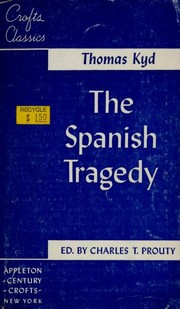
English Renaissance theatre · 1587
The Spanish Tragedy
by Thomas Kyd
Play by Thomas Kyd
- 1587
- English Renaissance theatre
Summary
The Spanish Tragedy, or Hieronimo is Mad Again is an Elizabethan tragedy written by Thomas Kyd between 1582 and 1592. Highly popular and influential in its time, The Spanish Tragedy established a new genre in English theatre: the revenge play or revenge tragedy. It is considered one of the most influential plays of the Renaissance theatre. The play contains several violent murders and personifies Revenge as its own character. The Spanish Tragedy is often considered to be the first mature Elizabethan drama, a claim disputed with Christopher Marlowe's Tamburlaine, and was parodied by many Elizabethan and Jacobean playwrights, including Marlowe, William Shakespeare and Ben Jonson.
Source: Wikipedia (CC BY-SA).
Historical Background
Thomas Kyd (1558-1594) wrote The Spanish Tragedy in the late 1580s; scholars such as J. R. Mulryne have concluded that 1587 remains the most likely year of completion, though it did not reach print until 1592. It emerged from the vigorous new commercial theatre culture of Elizabethan London, alongside the rise of blank-verse tragedy pioneered by Christopher Marlowe and the "University Wits" (though Kyd, lacking a university education, is not usually counted among them). Kyd drew heavily on Senecan tragedy - its ghost, revenge motif, stichomythia, and rhetorical set-pieces - filtering classical models through native English dramatic energy and a tightly engineered plot. Staged by Lord Strange's Men and later revived by the Admiral's Men, the play became one of the most popular and frequently revived works of its era; Philip Henslowe's diary records repeated performances and payments for additions to the text, sometimes attributed to Ben Jonson. Its enormous popularity established revenge tragedy as a dominant Elizabethan and Jacobean genre, and it was widely referenced, quoted, and parodied by contemporaries. Kyd himself remains a shadowy figure, known chiefly through this single confidently attributed play; his 1593 arrest and interrogation, connected to the Christopher Marlowe affair, effectively ended his career shortly before his early death.
The Story
Hieronimo, Knight Marshal of Spain, discovers his son Horatio murdered - hanged and stabbed in his own garden. The killers are Lorenzo, nephew to the King of Spain, and Balthazar, a captured Portuguese prince, both rivals for the love of Bel-imperia, Horatio's beloved and Lorenzo's sister. The action is framed by a supernatural device: the ghost of Don Andrea, a Spanish courtier slain before the play begins, and the allegorical figure of Revenge watch from above, treating the unfolding events as a spectacle that will satisfy the ghost's demand for vengeance. Grief-stricken and driven toward madness, Hieronimo finds that ordinary channels of justice are blocked because the murderers are protected by rank and court favor. He gathers proof through a letter written in blood by Bel-imperia and painstaking investigation, feigning compliance with the court while plotting retribution. Bel-imperia, equally determined to avenge Horatio, joins Hieronimo's scheme. The play culminates in a court entertainment - a play-within-the-play that Hieronimo stages before the King and nobles - in which the actors, unknown to the onstage audience, inflict real deaths: Hieronimo's character stabs and kills Lorenzo's character, and Bel-imperia's character stabs and kills Balthazar's character before killing herself. Hieronimo, having exacted vengeance, bites out his own tongue to avoid betraying his confederates before finally killing himself. Revenge closes the play promising further torment for the guilty in the afterlife, framing the entire bloody sequence as satisfying justice beyond the reach of earthly law.
Themes
- Revenge versus justice
- The failure of institutional/legal justice
- Madness as response to grief
- Fate, providence, and the supernatural frame
- Machiavellian court intrigue
- Performance, theatricality, and the play-within-a-play
- Grief and parental loss
- Honor and rank in a corrupt court
Literary Devices
- Play-within-a-play — Hieronimo's court entertainment becomes the vehicle for real murders, collapsing fiction into fact
- Senecan revenge-tragedy conventions — ghost, chorus figure, dismemberment, and rhetorical excess drawn from classical models
- Framing device — the Ghost of Andrea and Revenge observe and comment on the action as an onstage audience
- Soliloquy — Hieronimo's extended speeches externalize his grief, doubt, and resolve
- Dramatic irony — the audience knows the staged play's daggers are real while the onstage court does not
- Feigned madness — Hieronimo's performance of distraction masks calculated purpose
- Multilingual/rhetorical set-pieces — Latin tags and heightened oratory signal classical learning and heighten pathos
- Blood as visual and verbal motif — letters and props steeped in blood mark the escalating violence
Symbolism
- The bloody handkerchief — Hieronimo's memento of Horatio's murder, a recurring emblem of grief and the demand for vengeance
- The arbour/garden — the site of Horatio's murder, subverting the garden's traditional associations of safety and love into one of violence
- The play-within-the-play — theatre itself as an instrument that exposes hidden truth and delivers justice
- Revenge and the Ghost of Andrea — personified forces symbolizing the inescapability of retribution and a fatalistic universe
Critical Interpretation
Critics have long placed The Spanish Tragedy at the origin point of the English revenge-tragedy tradition, reading it as the formal ancestor of Hamlet and other Jacobean revenge plays. Fredson Bowers's influential study Elizabethan Revenge Tragedy, 1587-1642 treated the play as a foundational template - delayed revenge, feigned madness, a play-within-a-play, and a body-strewn climax - for the genre's conventions. Later criticism has taken Hieronimo's predicament more seriously as a meditation on the inadequacy of legal and political institutions to deliver justice to the powerless, making the play's violence a critique of a corrupt aristocratic order rather than mere sensationalism. T. S. Eliot's essays on Seneca's influence on Elizabethan drama helped keep Kyd's reputation alive for modern readers, and questions of authorship persist around the additional passages (including the famous "Painter" scene) added in later printed editions, often attributed to Ben Jonson. The play's self-conscious theatricality - drama commenting on the power and danger of drama itself - has also drawn sustained metatheatrical analysis.
Influence
The Spanish Tragedy is widely regarded as the founding work of English revenge tragedy, establishing conventions - a ghost demanding vengeance, delayed and calculated retribution, feigned madness, a climactic play-within-a-play, and a stage littered with bodies - that later dramatists reworked repeatedly. Its most famous descendant is Shakespeare's Hamlet, which shares its revenge-plot structure and interest in performed madness. The play was enormously popular in its own day, referenced, quoted, and parodied by contemporaries including Ben Jonson and Marlowe, a testament to how thoroughly its lines and situations entered the era's shared theatrical vocabulary. It helped cement blank verse and Senecan structure as the vehicle for popular tragedy on the London stage.
Related Works
- Hamlet — William Shakespeare
- Doctor Faustus — Christopher Marlowe
- The Revenger's Tragedy — Thomas Middleton (attrib.)
- The Duchess of Malfi — John Webster
- Tamburlaine — Christopher Marlowe
Curator's Notes
- 1The play's alternate title, Hieronimo is Mad Again, reflects how central the hero's feigned/real madness was to its contemporary popularity.
- 2Philip Henslowe's diary records payments for 'additions' to the play, evidence of its long stage life and revision by other hands.
- 3Thomas Kyd is not confidently credited with any other surviving play, making The Spanish Tragedy his sole major dramatic legacy.
- 4The play was so popular that its lines and situations were parodied by rival playwrights for years after its first performance.
- 5Kyd's 1593 arrest, during which papers linking him to Christopher Marlowe were seized, is one of the best-documented biographical episodes of any Elizabethan dramatist.
For the Exam
UGC NET English commonly tests The Spanish Tragedy as the originator of English revenge tragedy: expect questions on its Senecan influences, the ghost-and-Revenge framing device, the play-within-a-play climax, Hieronimo as a revenge-tragedy prototype for Hamlet, and its place in the pre-Shakespearean drama timeline. Candidates should be able to date the play (c. 1587, printed 1592), name Thomas Kyd, and distinguish its conventions (delay, madness, ghost, meta-theatre) from later Jacobean revenge tragedies.