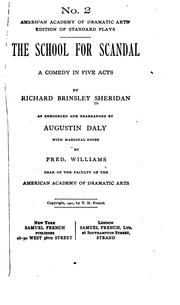
comedy of manners · 1777
The School for Scandal
play by Richard Brinsley Sheridan
- 1777
- comedy of manners
Summary
The School for Scandal is a comedy of manners written by Richard Brinsley Sheridan. It was first performed in London at Drury Lane Theatre on 8 May 1777.
Source: Wikipedia (CC BY-SA).
Historical Background
Richard Brinsley Sheridan (1751-1816) wrote The School for Scandal, a comedy of manners first performed at the Drury Lane Theatre in London on 8 May 1777, where Sheridan was manager. It arrived at a moment when English comedy had drifted toward sentimental drama, and Sheridan, alongside Oliver Goldsmith, is credited with reviving the wittier, satirical "laughing comedy" associated with Restoration dramatists such as William Congreve. The play satirizes fashionable London society's obsession with gossip and reputation, embodied in Lady Sneerwell and her circle, who trade in scandal as social currency. Central to the plot is the contrast between two brothers, Charles and Joseph Surface, whose names signal Sheridan's fondness for the "comedy of humours" naming tradition: Joseph performs sentimental virtue while secretly scheming, and Charles, though outwardly reckless, proves inwardly generous and honest. The play interweaves this brotherly contrast with the marital comedy of Sir Peter and Lady Teazle, testing the boundary between country innocence and fashionable corruption. Following his earlier success with The Rivals, Sheridan consolidated his reputation with this play, and it became one of the most frequently performed English comedies of the eighteenth century, remaining a cornerstone of the comedy-of-manners tradition.
The Story
The play centers on Sir Peter Teazle, an older gentleman recently married to a much younger country-bred wife, Lady Teazle, who is being drawn into the fashionable, malicious social circle of Lady Sneerwell, a scandalmonger who delights in ruining reputations through gossip, aided by the gossip-mongers Mrs. Candour, Crabtree, and Sir Benjamin Backbite. Sir Peter is guardian to two brothers, Charles and Joseph Surface, nephews of the wealthy Sir Oliver Surface, who has been abroad for years and returns to England incognito to test his nephews' true characters before deciding how to dispose of his fortune. Joseph poses publicly as a paragon of sentiment and moral rectitude while secretly courting Lady Sneerwell's favor and scheming to seduce Lady Teazle; Charles, though openly extravagant and in debt, is shown to be generous, warm-hearted, and honest. Sir Oliver disguises himself first as a moneylender, Mr. Premium, to observe Charles, who cheerfully sells off the family portraits but refuses to part with one of his uncle, revealing his underlying loyalty and affection. Sir Oliver then visits Joseph disguised as a poor relation, Mr. Stanley, and finds Joseph coldly refuses to help him, exposing his hypocrisy. The play's comic climax is the celebrated "screen scene," in which Lady Teazle, hiding behind a screen in Joseph's library to avoid discovery during an assignation, is exposed when Sir Peter and Charles arrive and the screen is knocked down, revealing her presence and unmasking Joseph's duplicity before the assembled characters. Lady Teazle, ashamed, renounces the scandal-mongering circle and reconciles with Sir Peter, Charles's true character is vindicated and he is rewarded with Sir Oliver's fortune and the hand of Maria, while Joseph and Lady Sneerwell are publicly disgraced and their schemes collapse in disorder.
Themes
- Hypocrisy versus true virtue
- Gossip and the destructive power of scandal
- Appearance versus reality
- Sentimentalism satirized
- Town versus country values
- Marriage and jealousy
- Reputation and social judgment
- Generosity and prodigality contrasted with false propriety
Literary Devices
- Antithesis - Charles and Joseph Surface embody a sustained contrast between apparent vice and apparent virtue
- Dramatic irony - the audience knows Joseph's hypocrisy and Sir Oliver's disguises long before the other characters do
- Disguise/incognito plot - Sir Oliver's assumed identities as Premium and Stanley drive the test of character
- Epigrammatic wit - the play is dense with polished, quotable aphorisms typical of Restoration-influenced comedy
- The screen scene - a celebrated coup de theatre using stage properties (a screen and a fallen library ladder) for comic exposure
- Comedy of humours naming - character names like Sneerwell, Backbite, Candour, and Surface signal traits
- Satire - targets the fashionable cult of scandal and sentimental posturing in Georgian society
Symbolism
- The screen - conceals deception and, when it falls, becomes the instrument of public exposure and truth
- The family portraits - represent lineage, loyalty, and true feeling, as Charles's refusal to sell his uncle's portrait reveals his real character
- Names as emblems - Surface signifies outward show versus inner reality; Sneerwell, Candour, and Backbite ironically or directly name their bearers' vices
Critical Interpretation
The School for Scandal has long been read as a defining example of the late-eighteenth-century revival of "laughing comedy" against the vogue for sentimental drama that Oliver Goldsmith also opposed. Critics have noted the play's debt to Restoration comedy of manners, particularly Congreve, in its polished dialogue and its satire of a fashionable, gossip-driven society, while also observing that Sheridan tempers Restoration cynicism with a more conventionally moral resolution in which true feeling (Charles's generosity) triumphs over false sentiment (Joseph's hypocrisy). The screen scene is frequently singled out as one of the most skillfully constructed pieces of stage comedy in English theatre, admired for its precise timing and visual comedy. Some criticism has focused on the play's ambivalent treatment of sentimentalism, noting that Sheridan satirizes affected sentiment while still relying on sentimental resolutions (reconciliation, reformed characters) to close the plot, making the play a hybrid rather than a pure repudiation of the sentimental mode.
Quotations
There's no possibility of being witty without a little ill-nature.
Spoken by Lady Sneerwell in Act I, Scene I, defending malicious wit amid the gossiping circle.
Influence
The School for Scandal is regarded as one of the finest and most enduring English comedies of manners, and it helped re-establish witty, satirical comedy on the London stage after decades of sentimental drama's popularity. It has remained in continuous performance since its premiere and is frequently studied alongside Sheridan's The Rivals as the high point of eighteenth-century English comic theatre. Its character types, particularly the hypocritical Joseph Surface and the gossiping Lady Sneerwell circle, became touchstones for later satires of social hypocrisy and scandal culture in English literature and theatre, and the play is often cited as a bridge between Restoration comedy and the comedy of manners revived later by writers such as Oscar Wilde.
Related Works
- The Rivals by Richard Brinsley Sheridan
- The Way of the World by William Congreve
- She Stoops to Conquer by Oliver Goldsmith
- The Importance of Being Earnest by Oscar Wilde
Curator's Notes
- 1The play premiered at Drury Lane Theatre on 8 May 1777, when Sheridan himself was the theatre's manager.
- 2The 'screen scene' in Act IV is often singled out as one of the most celebrated scenes of physical stage comedy in English drama.
- 3Sheridan had already achieved success with The Rivals two years earlier, and The School for Scandal cemented his reputation as the leading comic dramatist of his era.
- 4Many character names in the play, such as Sneerwell, Backbite, and Candour, function as ironic or literal labels for their personalities, a device inherited from the comedy of humours tradition.
For the Exam
UGC NET English frequently tests The School for Scandal as a key text of the Restoration-influenced "comedy of manners" revival against sentimental comedy, alongside Goldsmith's She Stoops to Conquer. Expect questions on character-author matching (Sheridan), the contrast between Charles and Joseph Surface as a study in appearance versus reality, the significance of the screen scene, and the play's place in eighteenth-century English theatre history between Restoration comedy and later Wildean comedy of manners.