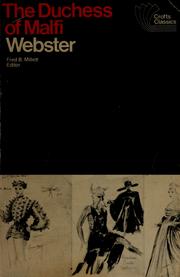
revenge tragedy · 1623
The Duchess of Malfi
by John Webster
1623 tragedy by John Webster
- 1623
- revenge tragedy
Summary
The Duchess of Malfi is a Jacobean revenge tragedy written by English dramatist John Webster in 1612–1613. It was first performed privately at the Blackfriars Theatre, then later to a larger audience at The Globe, in 1613–1614.
Source: Wikipedia (CC BY-SA).
Historical Background
John Webster (c.1578-1634) wrote The Duchess of Malfi in 1612-13, drawing on William Painter's The Palace of Pleasure, itself derived from Matteo Bandello's novella and, further back, the real life of Giovanna d'Aragona, Duchess of Amalfi. It was first performed privately by the King's Men at the Blackfriars Theatre, then publicly at the Globe, around 1613-14, and printed in 1623. Webster, a contemporary of Shakespeare working in the Jacobean period, is best known for two great tragedies of blood, this play and The White Devil. The Duchess of Malfi belongs to the tradition of revenge tragedy but is distinctive for its focus on a virtuous, self-determining widow destroyed by the tyranny of her own brothers, and for its unflinching exploration of corruption, madness, and mortality in an Italianate court setting. Its dense, aphoristic language, macabre stagecraft, and moral ambiguity mark the culmination of Jacobean tragic style, standing alongside Shakespeare and Middleton as a high point of English Renaissance drama.
The Story
The widowed Duchess of Malfi secretly marries her steward Antonio Bologna, defying the wishes of her twin brother Ferdinand, Duke of Calabria, and her other brother, the Cardinal, who forbid her remarriage out of pride, greed for her inheritance, and, in Ferdinand's case, a disturbing obsessive fixation. The Duchess bears Antonio children in secret, aided by her waiting-woman Cariola. Ferdinand plants the malcontent Bosola as a spy within her household. When Bosola uncovers the marriage, the brothers force the Duchess and Antonio into flight and separation. Ferdinand, sinking into psychological cruelty, has the Duchess imprisoned and tormented with a wax effigy of Antonio's supposed corpse and a masque of madmen, before ordering Bosola to strangle her along with Cariola and her children. Ferdinand then descends into madness, afflicted with lycanthropia, while Bosola, stricken with guilt and then betrayed by the Cardinal, turns avenger. In the bloody final act, Bosola kills the Cardinal's mistress Julia, then the Cardinal himself, and fatally stabs Antonio by mistake in the dark before he too is killed; Ferdinand, now insane, kills Bosola and is killed in turn. The Duchess's young son by Antonio is left to inherit Malfi, the sole survivor amid the carnage.
Themes
- Tyranny of patriarchal and fraternal authority over women's autonomy
- Corruption and decay beneath courtly and ecclesiastical power
- Death, mortality, and the theatricality of dying well
- Madness and psychological disintegration
- Class transgression through the Duchess's marriage to her steward
- Revenge and the moral corrosion of the avenger
- Surveillance, espionage, and the malcontent figure
- Appearance versus reality in a corrupt court
Literary Devices
- Dramatic irony - the audience knows of the secret marriage long before the brothers do, heightening dread
- Macabre stage imagery - the wax effigies and the dance of madmen used to torment the Duchess
- Aphoristic, sententious dialogue - characters speak in gnomic, quotable maxims common to Jacobean tragedy
- Dumb show and masque - ritualized theatrical devices used to convey horror and mockery
- Foil characterization - Bosola's conscience contrasts with Ferdinand's and the Cardinal's remorselessness
- Blank verse mixed with prose - shifting register marking status and psychological state
- Symbolic animal imagery - wolves and lycanthropia figuring bestial cruelty
- Echo scene - Antonio hears his dead wife's voice as an eerie premonition of his own death
Symbolism
- The wax effigies of Antonio and the children - false death used as psychological torture
- Ferdinand's lycanthropia - the collapse of human nobility into bestial savagery
- The horoscope Antonio casts - fate and the illusion of controlling one's destiny
- Poison and the Cardinal's poisoned Bible - corruption disguised as sanctity
- Darkness and night scenes - moral blindness and concealment pervading the court
Critical Interpretation
The Duchess of Malfi has long been read as both a revenge tragedy and a proto-feminist tragedy of a woman destroyed for asserting sexual and marital independence. Critics have debated whether the play endorses or merely stages misogynistic anxieties, given the brothers' obsessive control over the Duchess's body and choices. T. S. Eliot praised Webster's macabre imagination and his preoccupation with death, famously noting that Webster "was much possessed by death." The character of Bosola has drawn particular critical attention as a study in the corrupted intelligencer whose conscience awakens too late, embodying the play's broader interest in complicity and moral compromise within a decaying court. The play's structural excess in its final act, with its cascade of killings, has occasioned debate over whether it represents dramatic weakness or a deliberate vision of a world consumed by its own corruption. Feminist critics in particular have reclaimed the Duchess as a tragic heroine whose dignity in death, especially her line asserting her identity, offers a rare instance of female agency in Jacobean drama.
Quotations
I am Duchess of Malfi still.
Her defiant assertion of identity and dignity moments before her death, widely regarded as the play's most famous line.
Cover her face; mine eyes dazzle: she died young.
Ferdinand's stunned reaction upon seeing his sister's corpse, revealing a flicker of horror and remorse.
Influence
The Duchess of Malfi is regarded, alongside Webster's The White Devil, as one of the great achievements of Jacobean tragedy after Shakespeare, admired for its intense poetic language and unflinching depiction of corruption and death. It has remained a staple of the English stage and academic curricula, frequently revived by major companies and studied as a central text of English Renaissance theatre. T. S. Eliot's engagement with Webster's imagery of mortality helped secure the playwright's modern critical reputation. The play's portrait of a resilient, self-possessed heroine destroyed by patriarchal tyranny has made it an important text in feminist literary criticism and continues to shape scholarly discussion of gender and power in early modern drama.
Adaptations
- Royal Shakespeare Company and National Theatre productions have staged the play repeatedly as part of the Jacobean repertoire
- BBC television adaptation broadcast as part of British television's classic drama strand
Related Works
- The White Devil by John Webster
- The Revenger's Tragedy attributed to Thomas Middleton
- Hamlet by William Shakespeare
- The Spanish Tragedy by Thomas Kyd
- Women Beware Women by Thomas Middleton
Curator's Notes
- 1The play draws on the real historical figure of Giovanna d'Aragona, a 16th-century Duchess of Amalfi.
- 2It was first staged by the King's Men, the same company that performed Shakespeare's plays.
- 3T. S. Eliot's famous line that Webster 'was much possessed by death' has become a standard critical touchstone for the playwright.
- 4The play was printed in 1623, the same year as Shakespeare's First Folio.
For the Exam
UGC NET English frequently tests The Duchess of Malfi under Jacobean/Renaissance drama, asking students to identify the playwright, genre (revenge tragedy), key characters (Bosola, Ferdinand, the Cardinal), and the famous line "I am Duchess of Malfi still." Questions may probe themes of patriarchal control, the malcontent figure, and comparisons with Shakespearean tragedy or Middleton's revenge plays. Candidates should know Webster's dates, his other major work The White Devil, and the play's reputation for macabre imagery and moral ambiguity, as these recur in both objective and analytical questions.