African American literature · 1977
Song of Solomon
novel by Toni Morrison
- 1977
- African American literature
- ◆ Nobel-winning author
Summary
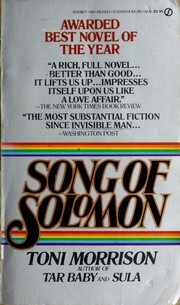
Song of Solomon is a 1977 novel by American author Toni Morrison, her third to be published. It follows the life of Macon "Milkman" Dead III, an African-American man living in Michigan, from birth to adulthood.
Source: Wikipedia (CC BY-SA).
Historical Background
Published in 1977, Song of Solomon was Toni Morrison's third novel and the book that brought her to national prominence, winning the National Book Critics Circle Award and making her the first African American writer since Richard Wright (whose Native Son was chosen in 1940) to be selected as a Book-of-the-Month Club main selection. Morrison wrote it in the aftermath of her father's death and dedicated the book to him; she has said that after he died she deliberately sought his voice and stories about the men he had known, and that this shaped the novel's concerns and its focus on male characters. Set primarily in an unnamed Michigan town often identified with Detroit, with an extended journey south to Pennsylvania and Virginia, the novel emerged from the post-Civil Rights, Black Arts era, when African American writers were reclaiming vernacular speech, folklore, and oral history as literary material. Morrison drew on African American folktales, particularly the legend of flying Africans who escaped slavery by taking wing, as well as biblical naming traditions and genealogical record-keeping, to construct a multigenerational family saga. The novel reflects her broader project of centering black interiority and community life rather than framing black experience solely through white oppression, while still reckoning fully with slavery's legacy and its distortions of identity, naming, and inheritance.
The Story
The novel follows Macon 'Milkman' Dead III, born in a Michigan city on the day a man attempts to fly off a hospital roof with homemade wings. Milkman grows up alienated: his father Macon Jr. is a cold, propertied landlord obsessed with wealth; his mother Ruth is emotionally starved; his aunt Pilate, a bootlegger who was born without a navel, lives outside respectable society with her daughter Reba and granddaughter Hagar, who becomes Milkman's cousin and long-suffering lover. Restless and self-absorbed, Milkman sets off south in pursuit of a supposed cache of gold, following clues tied to his grandfather's murder and the family's dispossessed land. The material quest gradually becomes a genealogical and spiritual one: in Danville, Pennsylvania, where his grandfather built the farm called Lincoln's Heaven, and then in Shalimar, Virginia, Milkman pieces together his family history through place-names, a children's song, and oral testimony, discovering that his great-grandfather Solomon was one of the legendary flying Africans who abandoned his family to escape slavery, leaving behind his wife Ryna and his youngest son Jake (Milkman's grandfather). Stripped of his materialism and arrogance, Milkman is transformed by this recovered history and by his bond with Pilate. After they bury Jake's bones at Solomon's Leap, Pilate is killed by a bullet meant for Milkman, fired by his vengeful friend Guitar. In the novel's ambiguous final scene, Milkman calls out Guitar's name and leaps toward him, an act read as both surrender to death and an assertion of the flight and self-possession his ancestors embodied.
Themes
- Naming and identity
- Flight as escape and self-possession
- Materialism versus community and love
- Ancestry, genealogy, and the reclaiming of history
- Gender and the constraints on women's lives
- The legacy of slavery within family structures
- Individual selfhood versus communal responsibility
- The recovery of African American folk culture
Literary Devices
- Magical realism — the flying men, Pilate's missing navel, and folkloric elements blend into an otherwise realist narrative
- Allegorical and biblical naming — characters' names (Dead, Pilate, Milkman, Solomon) carry ironic or symbolic weight
- Nonlinear, genealogical structure — the plot unfolds as a detective-like search backward through family history
- Oral storytelling and song — a children's rhyme about Solomon encodes buried family history
- Circular/parallel structure — the opening flight (Robert Smith) and closing leap (Milkman) frame the novel
- Free indirect discourse — shifting close narration exposes multiple characters' interior lives
- Symbolic geography — the move from urban Michigan to rural Pennsylvania and Virginia maps a journey from alienation to rootedness
Symbolism
- Flight — literal and metaphorical escape, ancestral power, but also abandonment
- Pilate's earring and tin box — inherited identity in place of material wealth
- Milkman's limp and Guitar's obsession with balance — imbalance between self-interest and communal justice
- The green bag Pilate carries — mistaken for gold, actually holding human remains, deflating materialist expectations
- Names given by white bureaucrats (Dead) versus names preserved in family and community memory — the violence and resilience of naming
- Solomon's Leap — the site of ancestral flight and Milkman's final, ambiguous leap
Critical Interpretation
Song of Solomon has been central to establishing Morrison's reputation as a major American novelist and has generated extensive criticism across several schools. Feminist critics have examined its treatment of Pilate, Ruth, Hagar, and Corinthians as figures constrained by patriarchal expectations, debating whether the novel's focus on Milkman's male quest for identity subordinates its women characters or critiques that very subordination. Africanist and folklore-oriented critics, building on Morrison's own stated interests, have traced the novel's roots in African American oral traditions, spirituals, and the flying-African myth, reading the book as a deliberate act of cultural reclamation. Psychoanalytic and postcolonial approaches have focused on naming, fragmented genealogy, and the psychic wounds of slavery as they reproduce across generations. The novel is also frequently discussed in debates over Morrison's narrative technique, particularly her blending of realism with folkloric and mythic elements, and her ambiguous, open ending, which critics have read as resisting closure and Western individualist narratives of triumph.
Quotations
If you surrendered to the air, you could ride it.
The novel's closing line: 'For now he knew what Shalimar knew: If you surrendered to the air, you could ride it.' Narrator, on flight as surrender and mastery.
You wanna fly, you got to give up the shit that weighs you down.
Guitar, commenting on a white peacock unable to fly under the weight of its plumage (Part 1, the used-car-lot scene) — the novel's central metaphor of flight requiring release from material burdens
I wish I'd a knowed more people. I would of loved 'em all. If I'd a knowed more, I would a loved more.
Pilate's dying words after she is shot, near the novel's end, on love as life's essential value
Influence
Song of Solomon helped cement Toni Morrison's place at the center of the American literary canon and paved the way for her subsequent novels, including Beloved, which extended her exploration of slavery's inherited trauma. It is widely credited with expanding the possibilities of the African American novel by fusing realist family saga with folklore, myth, and nonlinear genealogical structure, influencing later writers who blend historical fiction with folkloric elements. The novel's treatment of naming, flight, and reclaimed ancestry has become a touchstone in African American literary studies and in broader discussions of diasporic identity. Its canonical status was reinforced by its selection for Oprah's Book Club and its frequent inclusion on university syllabi and best-novels lists.
Related Works
- Beloved — Toni Morrison
- The Bluest Eye — Toni Morrison
- Their Eyes Were Watching God — Zora Neale Hurston
- Invisible Man — Ralph Ellison
- One Hundred Years of Solitude — Gabriel García Márquez
- Roots — Alex Haley
Curator's Notes
- 1Song of Solomon won the National Book Critics Circle Award for Fiction, announced in January 1978 for the 1977 publishing year.
- 2It made Morrison the first African American author since Richard Wright's Native Son (1940) to be a main selection of the Book-of-the-Month Club.
- 3The novel is dedicated to Morrison's father, who died shortly before she wrote it; Morrison said she gained access to the material only after his death.
- 4President Barack Obama has named the novel among his favorite books.
- 5The novel draws on the African American folktale of the 'flying Africans,' also preserved in Gullah Geechee oral tradition.
For the Exam
UGC NET English frequently tests Song of Solomon on its authorship and publication context (Morrison's third novel, 1977), its central themes of naming, flight, and ancestry, and its place within African American and postcolonial literary studies alongside Beloved. Questions may probe the significance of character names (Milkman, Pilate, Guitar, Dead), the flying-African folklore motif, and Morrison's narrative technique combining realism with myth. Candidates should also be able to situate the novel within Morrison's oeuvre and broader debates on race, gender, and identity in twentieth-century American fiction.