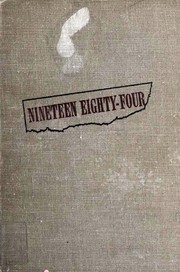
social science fiction · 1949
Nineteen Eighty-Four
1949 dystopian social science fiction novel by George Orwell
- 1949
- social science fiction
- political fiction
- science fiction
- dystopian fiction
Summary
Nineteen Eighty-Four is a dystopian speculative fiction novel by the English writer George Orwell. It was published on 8 June 1949 by Secker & Warburg as Orwell's ninth and final completed book. Thematically, it centres on totalitarianism, mass surveillance and repressive regimentation of people and behaviours. Nineteen Eighty-Four has been often regarded as a classic and has been acknowledged for its impact on twentieth-century literature.
Source: Wikipedia (CC BY-SA).
Historical Background
George Orwell wrote Nineteen Eighty-Four between 1946 and 1948, largely on the Isle of Jura in Scotland, while suffering from the tuberculosis that would kill him in January 1950. The novel emerged from his experiences with totalitarian propaganda and censorship: his service with the BBC during the Second World War, his firsthand encounter with Stalinist betrayal and suppression of dissent while fighting for the POUM militia in the Spanish Civil War, and his close observation of both Nazi Germany and Stalin's Soviet Union. Orwell drew on wartime Britain's austerity, rationing, and propaganda machinery for the novel's texture, while its ideological architecture reflects his lifelong critique of totalitarian ideology in any guise, left or right. The book was published on 8 June 1949 by Secker & Warburg as Orwell's final completed work. Its title is often read as a simple inversion of the year of composition, 1948, though Orwell never explained the choice definitively. Appearing at the dawn of the Cold War, the novel was quickly absorbed into anti-communist discourse in the West, even as Orwell himself, a democratic socialist, intended it as a warning against totalitarian tendencies wherever they arose, not an attack on socialism as such.
The Story
Winston Smith is a low-ranking member of the Outer Party in Oceania, one of three perpetually warring superstates, living under the totalitarian rule of the Party and its emblematic figurehead, Big Brother. Winston works at the Ministry of Truth, rewriting historical records to match the Party's ever-changing version of events. Disillusioned and secretly rebellious, he begins an illegal diary and enters into a forbidden love affair with Julia, a fellow Party member who shares his hatred of the regime, if not his intellectual preoccupations. The two rent a room above Mr. Charrington's shop, believing they have found a private refuge from the Party's omnipresent surveillance via telescreens and the Thought Police. Winston is drawn to O'Brien, an Inner Party member he suspects belongs to the Brotherhood, an underground resistance movement led by the Party's demonized enemy, Emmanuel Goldstein. O'Brien gives Winston a copy of Goldstein's forbidden book, which explains the Party's true methods and aims: not economic exploitation but power for its own sake, sustained by perpetual war, doublethink, and the control of reality itself. Winston and Julia are betrayed, arrested, and taken to the Ministry of Love, where it is revealed that O'Brien is a loyal Party agent who has been surveilling Winston all along. Through prolonged torture and psychological manipulation, culminating in Room 101 where Winston is confronted with his deepest fear, rats, he is broken, betrays Julia, and comes to love Big Brother, his individual will fully annihilated.
Themes
- Totalitarianism and absolute state control
- Surveillance and the erosion of privacy
- Manipulation of truth and historical memory
- Language as an instrument of thought control (Newspeak)
- Psychological control and the destruction of the self
- Betrayal and the impossibility of private loyalty
- Class and the illusion of revolution
- Perpetual war as social control
Literary Devices
- Newspeak — an invented, deliberately impoverished language designed to make dissenting thought literally unthinkable
- Doublethink — the capacity to hold two contradictory beliefs simultaneously and accept both
- Dramatic irony — readers grasp the Party's deceptions and Winston's doomed position before he fully does
- Symbolic/allegorical setting — Oceania's world functions as an extrapolated warning rather than realist prediction
- Framing devices — Goldstein's book and the Newspeak appendix embed expository political theory within the narrative
- Claustrophobic third-person limited narration — restricts readers to Winston's perception, heightening paranoia and unreliability of 'reality'
- Irony of Party slogans — 'War is Peace, Freedom is Slavery, Ignorance is Strength' encapsulate doublethink structurally
Symbolism
- Big Brother — the Party's all-seeing, possibly fictional figurehead, symbolizing the fusion of surveillance and worship of authority
- The glass paperweight — a fragile relic of an unrecoverable, private past and beauty, destroyed when Winston is arrested
- Room 101 — the individualized chamber of one's worst fear, symbolizing the Party's total psychological dominion
- The telescreen — omnipresent surveillance and the collapse of public and private life
- Newspeak/the Dictionary — language itself as the mechanism for eliminating the possibility of rebellious thought
Critical Interpretation
Nineteen Eighty-Four has been read variously as an anti-Stalinist tract, a general warning against totalitarianism of any political stripe, and a meditation on the fragility of objective truth and individual consciousness under absolute power. Cold War-era readers, especially in the United States, frequently enlisted the novel as anti-communist propaganda, a use Orwell's defenders note distorts his declared democratic-socialist commitments. Critics such as Irving Howe and Lionel Trilling engaged seriously with the novel's political philosophy, while later scholarship has emphasized its analysis of language and epistemology, particularly how Newspeak and doublethink dramatize the Sapir-Whorf-adjacent idea that control of language constrains the boundaries of thought. Feminist critics have scrutinized the novel's treatment of Julia and female sexuality. The book is also read through the lens of surveillance studies, its vocabulary, Big Brother, Room 101, thoughtcrime, having entered common political and cultural discourse well beyond literary criticism, a testament to its interpretive reach and continued relevance to debates about state power, media, and privacy.
Quotations
War is peace. Freedom is slavery. Ignorance is strength.
The Party's central slogan, embodying doublethink, appears on the Ministry of Truth building.
Big Brother is watching you.
The recurring Party caption accompanying posters of Big Brother's face, establishing the novel's surveillance motif.
Who controls the past controls the future: who controls the present controls the past.
A Party maxim explaining the Ministry of Truth's continual falsification of history.
If you want a picture of the future, imagine a boot stamping on a human face—forever.
O'Brien's description of the Party's ultimate vision of power, delivered to Winston during his interrogation.
He loved Big Brother.
The novel's final line, marking Winston's complete psychological surrender.
Influence
Nineteen Eighty-Four decisively shaped the vocabulary and imagination of political dystopia; terms like Big Brother, Orwellian, thoughtcrime, doublethink, and Room 101 entered everyday English usage as shorthand for surveillance states and propaganda. It stands alongside Aldous Huxley's Brave New World and Yevgeny Zamyatin's We as a foundational text of twentieth-century dystopian fiction, and it directly influenced later works of speculative political fiction, from Margaret Atwood's The Handmaid's Tale to countless films, television series, and popular debates about state surveillance, misinformation, and civil liberties. Its critique of manipulated language and falsified history continues to inform discussions of propaganda and "post-truth" politics.
Adaptations
- 1954 BBC television production Nineteen Eighty-Four
- 1956 film 1984, directed by Michael Anderson
- 1984 film Nineteen Eighty-Four, directed by Michael Radford, starring John Hurt and Richard Burton
Related Works
- Animal Farm by George Orwell
- Brave New World by Aldous Huxley
- We by Yevgeny Zamyatin
- The Handmaid's Tale by Margaret Atwood
- Darkness at Noon by Arthur Koestler
Curator's Notes
- 1Orwell's original working title was 'The Last Man in Europe' before he settled on Nineteen Eighty-Four.
- 2The novel was written while Orwell was gravely ill with tuberculosis on the remote Scottish island of Jura.
- 3It was Orwell's final completed book, published just months before his death in January 1950.
- 4The word 'Orwellian' derives directly from this novel and is now a standard English adjective for surveillance-state repression.
For the Exam
UGC NET English frequently tests Nineteen Eighty-Four on its dystopian genre classification alongside Huxley's Brave New World and Zamyatin's We; its key terms (Newspeak, doublethink, thoughtcrime, Big Brother, Room 101); its central slogans and their ideological function; Orwell's biographical-political context (Spanish Civil War, anti-totalitarianism, democratic socialism); and its place in his oeuvre alongside Animal Farm. Questions may also probe narrative technique, the function of Goldstein's book-within-the-book, and the novel's critical reception as Cold War allegory versus a broader warning against authoritarianism.