education novel · 1847
Jane Eyre
1847 novel by Charlotte Brontë
- 1847
- education novel
- autobiographical novel
- Gothic fiction
- romance
- Bildungsroman
Summary
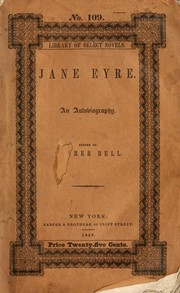
Jane Eyre is a novel by the English writer Charlotte Brontë. It was published under her pen name "Currer Bell" on 19 October 1847 by Smith, Elder & Co. of London. The first American edition was published in January 1848 by Harper & Brothers of New York. Jane Eyre is a bildungsroman that follows the experiences of its eponymous heroine, including her growth to adulthood and her love for Mr Rochester, the brooding master of Thornfield Hall.
Source: Wikipedia (CC BY-SA).
Historical Background
Charlotte Brontë wrote Jane Eyre while living at Haworth parsonage in Yorkshire with her sisters Emily and Anne, both also novelists. It was published on 19 October 1847 by Smith, Elder & Co. under the male pseudonym "Currer Bell," a strategy the Brontë sisters adopted to sidestep the gender bias facing women writers. The novel draws on Brontë's own experiences: her unhappy time at the Clergy Daughters' School at Cowan Bridge, often seen as a model for Lowood, and her work as a governess, a common but socially precarious occupation for genteel women without fortune. Its publication coincided with intense Victorian debate over women's education, employment, and independence. The novel's frank first-person voice, its critique of institutional cruelty and class hypocrisy, and its unconventional, plain heroine startled and thrilled contemporary readers, provoking charges of impropriety and "anti-Christian" feeling even as it became an immediate popular and critical success. It is considered a landmark of Victorian fiction, fusing Gothic atmosphere, romance, and social critique with an unprecedented interiority of female consciousness, and helped establish the bildungsroman as a vehicle for female self-development in English fiction.
The Story
Orphaned Jane Eyre endures a loveless childhood with her cruel aunt, Mrs. Reed, at Gateshead Hall before being sent to Lowood, a charity school marked by harsh discipline and privation, where her friend Helen Burns dies of typhus. After years as a pupil and then teacher, Jane leaves to become governess at Thornfield Hall, tutoring young Adèle Varens under the guardianship of the brooding Edward Rochester. Jane and Rochester fall in love and agree to marry, but at the altar she learns he is already married to Bertha Mason, a madwoman he keeps confined in Thornfield's attic. Refusing to become his mistress, Jane flees Thornfield, nearly perishing on the moors before being sheltered by the Rivers siblings, St John, Diana, and Mary, who turn out to be her cousins; she also learns she has inherited a fortune from her uncle, which she shares with them. St John Rivers proposes a loveless marriage and missionary partnership in India, but Jane refuses, hearing what she believes is Rochester's voice calling to her. She returns to find Thornfield burned down, Bertha dead, and Rochester blinded and maimed in the fire. Now his equal in independence and fortune, Jane marries him, and the novel closes with their reconciliation and family life.
Themes
- Love versus autonomy and self-respect
- Social class and social mobility
- Gender inequality and women's independence
- Religion, morality, and hypocrisy
- The search for belonging and family
- Passion versus reason/restraint
- Education and self-development
- Confinement and freedom
Literary Devices
- First-person narration — Jane's intimate, retrospective voice shapes reader sympathy and moral judgment
- Gothic imagery — Thornfield's attic, fire, and the 'madwoman' motif create suspense and psychological depth
- Symbolic settings — Gateshead, Lowood, Thornfield, Marsh End, and Ferndean mark distinct stages of Jane's growth
- Foreshadowing — recurring omens (the chestnut tree, dreams, storms) anticipate plot turns
- Direct authorial address — Jane's famous asides to 'Reader' break narrative distance
- Doubling — Bertha Mason functions as a dark counterpart to Jane's own suppressed passion
- Bildungsroman structure — episodic movement charts Jane's moral and psychological maturation
Symbolism
- The red-room — childhood trauma, imprisonment, and repressed rage
- Fire and ice imagery — passion versus emotional coldness across characters
- The chestnut tree split by lightning — the rupture of Jane and Rochester's first engagement
- Bertha Mason — Jane's repressed anger and the era's fears about female sexuality and autonomy
- Thornfield's attic — hidden secrets and the constraints placed on women
Critical Interpretation
Jane Eyre has drawn sustained feminist attention, notably Sandra Gilbert and Susan Gubar's The Madwoman in the Attic (1979), which reads Bertha Mason as Jane's repressed double and the novel as a study of female rage against patriarchal confinement. Postcolonial critics, following Gayatri Spivak's influential essay, have questioned the novel's treatment of Bertha as a Creole "other" sacrificed to secure Jane's happy ending, a critique that also shaped Jean Rhys's response in Wide Sargasso Sea. Marxist and class-focused readings examine Jane's precarious position as a genteel but penniless governess navigating rigid Victorian class structures. Early Victorian reviewers were divided, praising its originality and power while some, including Elizabeth Rigby, condemned it as morally dangerous and "anti-Christian" for its rebellious heroine. Later criticism has also explored the novel's religious dimensions, contrasting Jane's personal, non-dogmatic faith with the institutional zealotry of Mr. Brocklehurst and St John Rivers.
Quotations
Reader, I married him.
Jane's famous direct address opening the novel's final chapter, announcing her marriage to Rochester.
I am no bird; and no net ensnares me: I am a free human being with an independent will.
Jane asserts her autonomy to Rochester at Thornfield.
Do you think, because I am poor, obscure, plain, and little, I am soulless and heartless? ... I have as much soul as you, — and full as much heart!
Jane's declaration of equality to Rochester in the garden scene.
Influence
Jane Eyre helped establish the female Bildungsroman and the first-person "autobiographical" novel of interiority as a major mode in English fiction, influencing later writers such as George Eliot, Daphne du Maurier (Rebecca), and the Gothic romance tradition generally. Its unflinching, plain-spoken heroine reshaped expectations for female protagonists, offering a model of moral seriousness and self-assertion rather than passive virtue. Jean Rhys's Wide Sargasso Sea (1966) directly responds to the novel by giving voice to Bertha Mason, and the book's fusion of Gothic suspense with social realism and romance continued to shape popular fiction and feminist literary criticism into the twentieth century.
Adaptations
- Jane Eyre (1943 film, dir. Robert Stevenson, starring Joan Fontaine and Orson Welles)
- Jane Eyre (2011 film, dir. Cary Fukunaga, starring Mia Wasikowska and Michael Fassbender)
- Jane Eyre (1983 BBC television serial, starring Zelah Clarke and Timothy Dalton)
- Jane Eyre (2006 BBC television serial, starring Ruth Wilson and Toby Stephens)
Related Works
- Wuthering Heights by Emily Brontë
- Wide Sargasso Sea by Jean Rhys
- Rebecca by Daphne du Maurier
- Villette by Charlotte Brontë
- The Tenant of Wildfell Hall by Anne Brontë
- Great Expectations by Charles Dickens
Curator's Notes
- 1Charlotte Brontë published Jane Eyre under the androgynous pseudonym Currer Bell to avoid the gender bias facing women authors.
- 2The novel's subtitle, 'An Autobiography,' misled some early readers into thinking it was a real memoir.
- 3Lowood School is widely believed to be modeled on the Clergy Daughters' School at Cowan Bridge, which Charlotte and her sisters attended.
- 4Jane Eyre was an immediate bestseller in 1847, going through several printings within months of publication.
For the Exam
UGC NET English commonly tests Jane Eyre on its status as a Victorian Bildungsroman and Gothic romance, its narrative technique (first-person retrospective narration, direct reader address), its feminist themes of autonomy and equality, and its treatment of class and governess status. Examiners frequently probe the significance of Bertha Mason and the "madwoman in the attic" trope, especially via Gilbert and Gubar's feminist criticism and postcolonial readings linked to Jean Rhys's Wide Sargasso Sea. Questions may also cover setting symbolism (Gateshead, Lowood, Thornfield, Ferndean) and Charlotte Brontë's biography and place among the Brontë sisters.