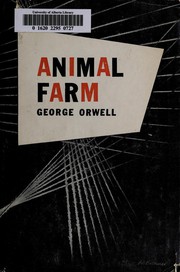
roman à clef · 1945
Animal Farm
1945 novella by George Orwell
- 1945
- roman à clef
- satirical fiction
- fable
- dystopian fiction
Summary
Animal Farm is a satirical allegorical dystopian novella, in the form of a beast fable, by George Orwell, first published in England on 17 August 1945. It follows the mistreated anthropomorphic farm animals of Manor Farm as they rebel against their human master, and are hoping to create a society where all animals can be equal, free, and happy away from human vices and interventions. However, the rebellion is hijacked and betrayed, and under the dictatorship of the pigs, the farm ends up in a dystopian state nearly identical to what it was before.
Source: Wikipedia (CC BY-SA).
Historical Background
Orwell wrote Animal Farm between November 1943 and February 1944, while working at the BBC and later as literary editor of Tribune, drawing on his disillusionment with Soviet communism that began during the Spanish Civil War (1936-37), where he witnessed communist suppression of rival leftist factions. Subtitled "A Fairy Story," the novella is a beast fable allegorizing the Russian Revolution of 1917 and its betrayal under Stalin. Old Major represents Marx and Lenin combined, Napoleon stands for Stalin, Snowball for Trotsky, Squealer for Soviet propaganda organs, and Boxer the carthorse for the exploited proletariat. Orwell struggled to find a publisher: wartime Britain was allied with the USSR, and several publishers, including Faber & Faber (where T.S. Eliot rejected it), were wary that the satire would damage relations with Stalin. It was finally published by Secker & Warburg on 17 August 1945, days after Japan's surrender brought the Second World War to its close. The book's success established Orwell's reputation and financial security; he died in 1950, shortly after completing Nineteen Eighty-Four.
The Story
On Manor Farm, the aged boar Old Major inspires the animals with a vision of rebellion against their human master, Mr. Jones, and dies soon after. The pigs Napoleon and Snowball lead the animals in a successful uprising, renaming the property Animal Farm and establishing Seven Commandments of Animalism, the chief being "All animals are equal." Initially the farm thrives under collective management, with the tireless carthorse Boxer adopting the motto "I will work harder." Napoleon and Snowball soon clash over the farm's direction, particularly the building of a windmill; Napoleon uses a pack of dogs he has secretly raised to drive Snowball off the farm and seizes total power. Using the persuasive pig Squealer to twist language and rewrite history, Napoleon gradually blames Snowball for every failure, alters the Commandments to suit the pigs' privileges, and begins trading with neighboring humans. The pigs move into the farmhouse, walk on two legs, and adopt human vices, while the other animals endure hardship and broken promises. Boxer, worked to exhaustion, is sold to a knacker when he collapses, though the pigs claim he died peacefully. In the final scene, the other animals watch through a window as the pigs dine and quarrel with human farmers, and find they can no longer distinguish pig from man.
Themes
- The corruption of revolutionary ideals by power
- Totalitarianism and the cult of leadership
- Propaganda, language, and the manipulation of truth
- Class inequality re-emerging under new rulers
- Exploitation of labor and the working class
- The failure of collective utopian idealism
- Historical revisionism and control of memory
Literary Devices
- Allegory — the entire farm narrative maps onto the Russian Revolution and Stalinist USSR
- Beast fable — anthropomorphized animals satirize human political behavior
- Irony — the Commandments' amendments (e.g., "all animals are equal, but some animals are more equal than others") expose hypocrisy
- Satire — mocks Soviet propaganda, show trials, and personality cults
- Symbolism — characters and objects stand for historical figures and institutions
- Repetition and sloganeering — simplified maxims like "Four legs good, two legs bad" mimic totalitarian propaganda techniques
- Foreshadowing — early hints (the pigs taking milk and apples) anticipate the final betrayal
Symbolism
- The pigs — the ruling communist elite/Bolshevik leadership
- Napoleon — Joseph Stalin and dictatorial power
- Snowball — Leon Trotsky, the exiled rival
- Boxer — the exploited proletariat and naive faith in the regime
- The windmill — Soviet industrialization projects and Five-Year Plans
- The Seven Commandments — the founding ideals of communism, progressively corrupted
Critical Interpretation
Animal Farm has been read chiefly as political allegory and satire, with critics tracing precise correspondences between its characters and events and specific figures and episodes of Soviet history, from the Russian Revolution through the Stalin-Trotsky power struggle and the purges. Critics have long debated its scope: some view it narrowly as an anti-Stalinist tract rather than an attack on socialism itself, noting Orwell's own commitment to democratic socialism, while others read it more broadly as a fable about the corrupting nature of power in any revolutionary movement. Its economy, clarity, and fable form have been praised as central to its enduring effectiveness as political satire, making complex history accessible. The novella is frequently paired with Nineteen Eighty-Four in discussions of Orwell's critique of totalitarianism, particularly his interest in propaganda and the manipulation of language as instruments of control. Its status as a Cold War-era text also drew scrutiny, including its complicated publication history and later use by anti-communist propagandists.
Quotations
All animals are equal, but some animals are more equal than others.
The Seven Commandments reduced to a single, self-contradicting maxim, spoken/painted near the novella's end to justify pig privilege.
Four legs good, two legs bad.
The sheep's simplified slogan, illustrating how propaganda reduces ideology to mindless chant.
I will work harder.
Boxer's personal motto, expressing his loyal, exploited labor under the new regime.
All animals are equal.
The original First Commandment established after the rebellion, later corrupted.
Influence
Animal Farm became one of the twentieth century's most influential political satires, cementing the beast fable as a viable vehicle for serious political critique and shaping later dystopian and allegorical fiction. Alongside Nineteen Eighty-Four, it made Orwell's name synonymous with warnings against totalitarianism, and terms and concepts associated with his work entered common political vocabulary. The novella has been widely used in schools worldwide as an accessible introduction to propaganda, authoritarianism, and revolutionary betrayal, and it remains a staple reference point in political commentary whenever revolutionary movements are seen to replicate the abuses they overthrew.
Adaptations
- Animal Farm (1954 animated film, Halas and Batchelor)
- Animal Farm (1999 television film, Hallmark)
Related Works
- Nineteen Eighty-Four by George Orwell
- Darkness at Noon by Arthur Koestler
- We by Yevgeny Zamyatin
- The Master and Margarita by Mikhail Bulgakov
- Homage to Catalonia by George Orwell
Curator's Notes
- 1Orwell subtitled the book 'A Fairy Story,' though most editions omit this from the cover.
- 2The novella was rejected by several British publishers; at Faber & Faber, T.S. Eliot's rejection letter objected on ideological grounds, questioning the book's anti-Soviet 'Trotskyite' viewpoint at a time when Britain and the USSR were wartime allies.
- 3The book was published on 17 August 1945, only days after Japan's surrender brought the Second World War to its end, complicating its reception given Britain's wartime alliance with the Soviet Union.
For the Exam
UGC NET English frequently tests Animal Farm as a set text for allegory, satire, and dystopian fiction, asking students to match characters (Napoleon, Snowball, Squealer, Boxer, Old Major) to their historical/political counterparts in the Russian Revolution and Stalinist USSR. Expect questions on genre classification (beast fable, roman à clef, dystopia), the significance of the altered Commandments, Orwell's use of propaganda and language manipulation as themes, and comparisons with Nineteen Eighty-Four. Publication date (1945) and Orwell's biographical context (Spanish Civil War, democratic socialism) are common factual questions.