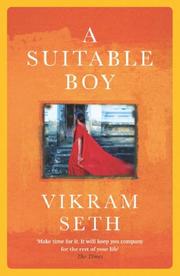
Summary
A Suitable Boy is a novel by Vikram Seth, published in 1993. With 1,349 pages, the English-language book is one of the longest novels published in a single volume.
Source: Wikipedia (CC BY-SA).
Historical Background
Vikram Seth wrote A Suitable Boy over nearly a decade, publishing it in 1993 as one of the longest novels ever produced in a single volume in the English language, running to roughly 1,349 pages. Set in the early 1950s, in the first years after Indian independence and Partition, the novel unfolds against a newly sovereign nation grappling with its identity: the first general election, land reform legislation, Hindu-Muslim tensions, and the dismantling of princely and zamindari privilege. Seth, already known for The Golden Gate, a novel in verse, turned to a sprawling realist mode modeled explicitly on nineteenth-century social novelists, especially Tolstoy and, by his own acknowledgment, the classic marriage-plot tradition. The book follows four extended families—Hindu and Muslim, landed and mercantile—linked through the search for a husband for Lata Mehra. Seth drew on his own family background and extensive research into the period's politics, law, and social customs to construct a panoramic portrait of a society in transition. The novel's scale and its refusal of Western modernist fragmentation were deliberate choices, aiming to recover a comprehensive, community-oriented realism suited to depicting a whole society rather than a single consciousness.
The Story
Set in the fictional town of Brahmpur and other Indian cities in 1951-52, the novel opens at the wedding of Savita Mehra to Pran Kapoor, after which Savita's mother, Mrs. Rupa Mehra, promptly resolves to find an equally suitable husband for her younger daughter, Lata. Lata is pursued by three very different men: Kabir Durrani, a Muslim fellow student she falls for despite the near-impossibility of an interfaith match; Amit Chatterji, a poet from a literary Calcutta family; and Haresh Khanna, a practical, hardworking shoe-industry professional. Interwoven with Lata's courtship is the story of the Kapoor family, particularly Maan Kapoor, son of the reformist Revenue Minister Mahesh Kapoor, whose affair with the courtesan-singer Saeeda Bai scandalizes his family and entangles him in violence and political consequence. Another strand follows the Khan family, headed by the Nawab Sahib of Baitar, and the fortunes of the declining Muslim aristocracy amid land reform and communal tension. Political life runs throughout: a general election, debates over the Zamindari Abolition Act, and a catastrophic stampede during a religious festival on the banks of the Ganges. The narrative moves between drawing rooms, courtrooms, election rallies, and riverside ghats, ultimately converging on Lata's decision among her three suitors, resolved with the quiet, unsentimental realism characteristic of Seth's method.
Themes
- Marriage, choice, and social duty
- Communal (Hindu-Muslim) relations after Partition
- Land reform and the decline of the zamindari class
- Nation-building and post-independence democracy
- Family, generational conflict, and tradition versus modernity
- Caste and class negotiation in courtship
- Art, poetry, and cultural life as social markers
- Individual desire versus familial and communal expectation
Literary Devices
- Multiplot structure — four interwoven family narratives create a panoramic social canvas
- Free indirect discourse — shifts fluidly among characters' perspectives without authorial intrusion
- Realist social-novel form — deliberately modeled on nineteenth-century realism rather than modernist experiment
- Interpolated documents — letters, poems, and political speeches embedded within the narrative
- Ensemble characterization — no single protagonist; the community itself functions as the subject
- Irony and comedy of manners — gently satirical treatment of social pretension and matchmaking rituals
Symbolism
- Shoes and the shoe trade — commerce, practicality, and the modernizing economy as counterpoint to old aristocratic values
- The Ganges and religious festival scenes — the confluence and collision of communities and faiths
- Land and zamindari estates — the passing of feudal power in independent India
- Poetry and music (Amit's writing, Saeeda Bai's singing) — competing claims of art versus social respectability
Critical Interpretation
Critics have most often discussed A Suitable Boy in terms of genre and scale: its deliberate revival of the nineteenth-century realist social novel at a moment when postcolonial and postmodern fiction favored fragmentation, magical realism, and self-conscious narration. The comparison most frequently invoked is to Tolstoy, particularly the multi-family, historically embedded structure seen in works like Anna Karenina, and to the English marriage-plot tradition associated with Jane Austen. Some reviewers praised its readability and comprehensiveness as a portrait of newly independent India, while others questioned whether its conventional realism and comic, marriage-focused plot undersold the trauma of Partition and communal violence explored more searingly by contemporaries. The novel is frequently read alongside other major Indian English novels of the period as part of a broader critical conversation about how Indian writers in English represent the nation, negotiate multiple languages and communities within a single English text, and position themselves relative to both Indian literary traditions and the Western novel form.
Influence
A Suitable Boy became a landmark of post-independence Indian fiction in English, demonstrating that large-scale realist narrative could command a mainstream international readership. Its success helped affirm the commercial and critical viability of long, socially panoramic novels by Indian writers, contributing to the broader visibility of Indian English fiction internationally in the 1990s. The novel is regularly taught and discussed alongside other major works of the "Indian novel in English" boom, and its 2020 television adaptation brought the story to a wide global audience, renewing critical and popular attention to Seth's method of social realism.
Adaptations
- A Suitable Boy (BBC One/Netflix television serial, 2020), directed by Mira Nair, adapted for television by Andrew Davies
Related Works
- Anna Karenina by Leo Tolstoy
- Midnight's Children by Salman Rushdie
- The God of Small Things by Arundhati Roy
- A Fine Balance by Rohinton Mistry
- The Golden Gate by Vikram Seth
- Pride and Prejudice by Jane Austen
Curator's Notes
- 1At roughly 1,349 pages, A Suitable Boy is often cited as one of the longest novels ever published in a single volume in the English language.
- 2Vikram Seth's previous novel, The Golden Gate, was written entirely in verse, making the prose realism of A Suitable Boy a deliberate departure in form.
- 3The novel was adapted into a television serial directed by Mira Nair, which aired in 2020.
For the Exam
UGC NET candidates should be able to identify A Suitable Boy as a 1993 novel by Vikram Seth set in early post-independence India (1951-52), know its multiplot structure following four families and Lata Mehra's choice among suitors, and be able to place it within debates on realism versus postmodern/postcolonial narrative experiment. Expect questions testing recognition of the novel's Tolstoyan realist mode, its treatment of communal relations and land reform, and its position in the wider canon of Indian English fiction alongside Rushdie, Roy, and Mistry.